

Human subjects and experiments
In 1936, Japanese wanted to advance the scientific level and thus show their power to the world's major powers. For this, they tried to find a new weapon that would enable them to access an easier victory while limiting the losses of soldiers. Their business was difficult and they opted for a scientific rather than a military weapon, more economical in men and means. The project of Shiro Ishii, physician at the hospital of the first Kyoto's army, was the creation and testing of chemical and biological weapons, without effects on allied armies, which are protected, but disastrous on enemy troops.
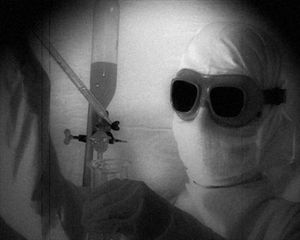
Japanese physician in camp
His project presented to the Grand General Staff in 1928 was accepted , and the necessary equipment was given, with outpost camps of Tokyo to keep absolute
discretion and a total secrecy.
To discover new harmful and deadly weapons on the human body , Shiro Ishii firstly study it alive to observe its working , weaknesses and
limitations.
In Manchuria, area of China then occupied by Japan, were all kinds of opponents of Japan, such as Chinese people whose country had been invaded , suspected of "
disloyalty " , agitators workers , soldiers and settlers from all countries (France , Russia, America , China) , prisoners,
and other foreign ( Korean , Russian communists, intellectuals, ... ) . These were therefore be easily prey to discreetly remove , to serve
as subjects for Shiro Ishii (experiences). But the
first subjects were prisoners sentenced to death and held at the Harbin Prison or " resistant " captured by the "kempetai" ( Japanese military police).
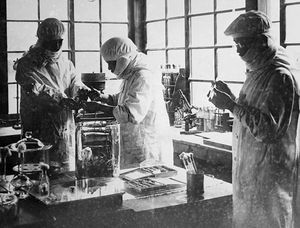 A medical team of 731 camp for their experimental work
To study human functioning and limitations of the body, Shiro Ishii and all members of his unit, the 731 , realized experiences of all kinds and record the results obtained on
sheets.
These results included the origin of the victim, the age, symptoms after having transmitted a disease or after performing an experiment, the duration of experiences ,
circumstances and manipulation of these. These cards were written from the
beginning of the experiment until the end or death of the individual , they shall transcribe pathologies .
We also know that the members of the 731 unit inoculating diseases to subjects by rats, fleas or previously infected humans , either by direct creation of the disease in the
subject's body. Human subjects are called "
maruta " Japanese word for block, or log.
Upon arrival at the camp , subjects for most aged of 20-40 years were numbered with paint on
their white uniform , and therefore they were not considered human beings.
In movies , documentaries and books that we
studied , some of these experiments are shown including:
- Fleas were contaminated with all kinds of diseases then inserted into capsules. Then, in a remote and isolated terrain, subjects were arranged in a circle and each equidistant from the center of the circle and its neighbor. They were tied to crosses and protected with a helmet and a copper plate for the body. Then began the experiment: A plane flying over the field and drop porcelain capsules on center of the circle.
Capsules burst on the ground and projected parts of porcelain and infected fleas. Copper plates and helmet protecting a minimum subjects of the bursts but infected fleas transmitted the virus through blood by biting. Doctors then studied pathologies of the disease on humans and the resistance thereof to the virus until the death of the subject.

Human subject crucified
- The human body resistance to pressure
variations: behind the windows of a sealed room are
scientists, equipped with timers and counters to study the experience. Doctors amplify the pressure of the room as and as the minutes pass. First, in this experiment, it is
observed that the subject suffers a very intense pain in the
head, the latter followed by a strong sweating throughout the body.
After having suffocate, the subject is knocked prone crushed under the weight of pressure and his body began to swell. Then the body drain himself of
all fluids (faeces, ...) and organs such as the intestines.
 Prisonner subjected to pressure
- Resistance of the human body to temperature variations : a subject is placed in a very cold inner or outer zone. Then, his hands are regularly sprayed with water, and the low temperature enables the freezing thereof. Frozen hands, the subject is led into a room, where doctors and learners observe the experience and taking notes. The hands of the subject are placed in a boiling water bath. We see that the skin of the arms of the subject crumples and off. The doctor takes a rod of iron and cut the skin, then it is removed from the arm by pulling sharply. We see the bones of the subject's skin and without a rest chair.
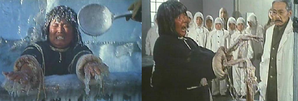 Thermal experiments on subject
- The human body resistance to diseases: the members of Unit 731 passed by all sorts of ways to transmit diseases such as plague, anthrax, dysentery, typhus, typhoid, Paratyphoid, cholera, botulism, brucellosis, gas gangrene, glanders, Influenza, meningitis, but also Salmonella, Smallpox, Tetanus, Encephalitis, Tuberculosis, Tularemia, hemorrhagic fever, etc...

Description of experience and 731 staff camp
So they could fill pages describing the pathologies of diseases by origin, age, gender of subjects and duration of diseases. It was an attempt to see how far the human body could withstand certain diseases according to certain criteria.
- Resistance to harmful gases and experiences of all kinds, in comparison with that of animals: Individuals of different ages and sex are attached in a sealed room with window and in this experience a dove. Behind the windows are doctors and students watching the scene. Gas is spread in the room and people begin to suffocate. Doctors compute the time it takes beings to die. Thus, they have a timer for the dove, and an other for humans. Dove die few seconds before subjects. The result of the experiment is transcribed on a sheet.
- The human vivisection: The individual
is stripped and asleep or even stay awake but is attached. Doctors open the torso to the pubis, then,
without any respect for the body of the subject, they observe the
body functioning. So they reverse or remove everything
that hides their vision. The body is mutilated everywhere.
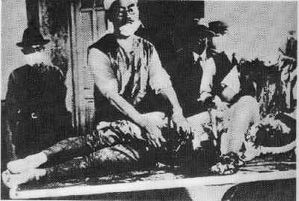
Vivisection of an awake by Ishii
They cut all the vital organs, which are still active, the heart still beats, liver, lungs and kidneys. These organs are then placed in jars filled with formalin to be more closely observed and analyzed. What remains of the individual after the operation is cast into a bag, then drive to the incinerator. Also other forms of experiments of this kind are used as cuttings members with scalpel (arms, face, legs, ...) on awake subjects.
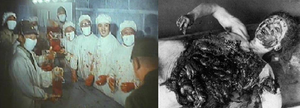 Medical staff and human body after vivisection
-
The resistance of eyes to the X-ray :
A person is placed on an operating table, there is attached. The doctors project in his eyes X-ray.
During this time they observe and compute the time to become totaly blind.
- The resistance to pain: Doctors put an individual on an operating chair and attach. They
put on his face probes to measure loudness of sound. Thus, they
extract all the teeth of the subject, without anesthesia, and with pliers. Then, they observe and record the pain and the intensity of
his cries, calculated on an equipment provided for that
purpose.
NEXT PART TRANSLATION IN PROGRESS
Please consult french version awaiting further.


/https%3A%2F%2Fassets.over-blog.com%2Ft%2Fcedistic%2Fcamera.png)
/idata%2F4150882%2Fmaladie.jpg)